Key Takeaways
- The viral story of Punch, a baby monkey rejected by his mother and troop at a Japanese zoo, mirrors what 85 to 90% of autism families report experiencing from their own extended families.
- Fear of the unknown, generational stigma, intimidation by unfamiliar behaviors, lack of effort, and unmet expectations are the most common reasons family members pull away after an autism diagnosis.
- Late diagnoses, like my son's at age 18, can sometimes shield families from overt rejection, but they come with their own set of invisible costs.
- Professional supports including family psychoeducation, Behavioral Skills Training (BST), and Acceptance and Commitment Therapy (ACT) can help repair or manage fractured family systems.
- Like Punch, children with autism don't need the whole world to accept them. They need the right people to show up.
If you've been anywhere on the internet this past week, you've probably seen him. A seven-month-old baby macaque monkey named Punch, clinging to a stuffed orangutan toy at Japan's Ichikawa City Zoo, alone on a rock while the rest of his troop carried on without him.
Punch was born in July 2025, but after a difficult labor, his mother rejected him. Zoo staff hand-raised him, gave him blankets and soft toys to ease his anxiety, and eventually reintroduced him to the troop. But the other monkeys wanted nothing to do with him. He was pushed away, ignored, and at one point dragged across the ground by an adult monkey while the world watched through their phone screens.
The internet erupted. The hashtag #KeepGoingPunch spread across TikTok, X, and Instagram. Millions of people who had never set foot in a Japanese zoo found themselves emotionally invested in whether this tiny monkey would be accepted by his own family.
I was one of them. But not for the reasons most people were.
Why Punch Hit Different
When I watched those videos of a small, vulnerable creature reaching out to a group that kept turning away, I didn't just see a baby monkey. I saw something that autism families live with every day.
The reaching out. The confusion. The stuffed animal standing in for the warmth that should have come from family. And the quiet, devastating question underneath all of it: Why don't they want to be around me?
I recently reviewed a discussion in an online autism parent discussion group where families were asked a straightforward question: Just wondering does anyone else's family show no interest in their autistic child?
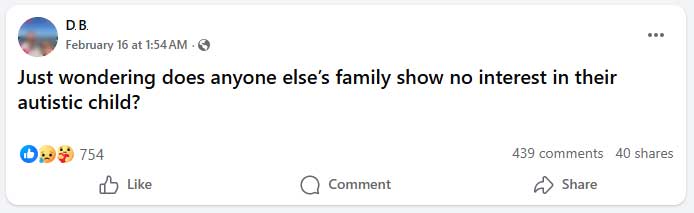
Roughly 85 to 90% of parents said their extended family members, including grandparents, aunts, uncles, and sometimes even co-parents, showed little to no interest in their child. Some described active avoidance. Others described a kind of willful ignorance, where relatives simply pretended the diagnosis didn't exist.
Only about 10 to 15% described having a real, engaged support system.
Punch went viral because his loneliness was visible. For autism families, that same loneliness often plays out behind closed doors, in unanswered invitations and empty chairs at birthday parties.
My Family's Story
Our path looked a little different than most, and I want to be honest about that.
My son wasn't diagnosed with Autism Spectrum Disorder (ASD) until he was 18. Eighteen years of navigating a world that didn't quite fit him, without a name for why. When the questions came (and there were plenty of them) we often couldn't answer them. We didn't have the language yet. We didn't have the framework. We were figuring it out in real time, just like he was.
In some ways, the late diagnosis was a strange kind of shield. Without a label, family members didn't have a diagnosis to reject. There was no moment where relatives suddenly got "busy" or stopped coming around because of a word on a piece of paper. Instead, people just accepted that's how he is. His quirks, his way of processing the world, his need for routine. It was all just... him.
But here's what I've learned since: that acceptance without understanding isn't the same thing as support. Some people absolutely leaned in. They showed up, they asked questions, and they made the effort to meet our son where he was. We're grateful for them. But others weren't rejecting a diagnosis because there wasn't one to reject. They just weren't curious enough to dig deeper. They weren't asking how to help or learning what he needed. And the absence of rejection isn't the same as the presence of a village.
And for families who do receive an early diagnosis, the experience is often far more brutal.
Why Family Pulls Away
Understanding the why doesn't excuse the behavior. But it can help you decide how to respond, and it can take some of the personal sting out of something that was never really about you or your child.
Based on what hundreds of parents shared in the community discussion, the reasons fall into a few consistent patterns.
Fear of the Unknown
This was the most common reason by far. Relatives simply don't know how to interact with a child with autism. They're afraid of triggering a meltdown or saying the wrong thing. That fear turns into distance. They step back instead of leaning in, because they don't understand sensory overwhelm or why your child might react in ways they don't expect.
of parents reported active avoidance or willful ignorance from extended family members regarding their child's diagnosis.
Think about Punch's troop. Primatologists noted that the other monkeys didn't reject him out of cruelty. They didn't know what to make of a baby who had been hand-raised by humans and didn't communicate the way they expected. The unfamiliarity itself became the barrier.
The same thing happens in families. When a child doesn't respond to hugs in the usual way, or doesn't make eye contact, or needs to leave the room during a family dinner, some relatives interpret that as rejection. They withdraw first to protect themselves from a hurt they've misread entirely.
Intimidation by Challenging Behaviors
Some moments are intense. A child who goes from calm to highly reactive in seconds can be overwhelming for someone who doesn't understand what's happening or how to help. Instead of asking questions or learning, some relatives just stop coming around.
Denial and Generational Stigma
This one runs deep. Some family members refuse to accept the diagnosis at all. They'll say things like "he just needs more discipline" or "she'll grow out of it." These responses are rooted in outdated beliefs, generational stigma that frames neurological differences as behavior problems.
In our case, without a formal diagnosis for 18 years, some of those conversations never happened directly. But the undercurrent was there. The unspoken implication that if we just parented differently, things would be "normal."
Lack of Effort
This is a hard truth. Spending time with a child with autism often requires patience, flexibility, and a willingness to learn. Some relatives find it easier to avoid the situation because accommodating a child's needs demands more effort than they're willing to give.
Unmet Expectations and Grief
Sometimes the distance isn't about your child at all. It's about the relationship the relative imagined having. The grandparent who pictured playing catch. The aunt who imagined long conversations. When a child doesn't interact in traditional, neurotypical ways, some relatives grieve those expectations quietly and pull away rather than adjust them.
The Double Grief
Here's what makes this so uniquely painful: you're already carrying the weight of the diagnosis itself. You're learning new terminology, scheduling assessments, fighting insurance companies, and restructuring your daily life around therapy schedules.
And then the people who were supposed to hold you up... step back.
Parents in the community described this as a "double grief." You're processing your own emotions about the diagnosis timeline while simultaneously losing the family support you assumed would be there. One parent described it as the feeling that your family is rejecting your reality, and that kind of pain doesn't have a quick fix.
That grief is valid. You are allowed to feel it without apology.
What Punch Gets Right
Here's why I think this little monkey struck such a deep chord with so many people, especially within the autism community.
Punch didn't do anything wrong. He was born into circumstances he didn't choose. He reached out for connection the only way he knew how. And when the group wouldn't accept him, the zookeepers didn't force it. They gave him something soft to hold onto. They stayed close. They watched carefully. And they gave him time.
Then, slowly, things started to shift. An adult monkey named Onsing drew Punch into a long embrace. Others began grooming him, a sign of trust and acceptance in macaque social groups. The zoo's staff said that Punch shows remarkable resilience and continues learning how to be part of the troop.
That's the part of the story that matters most. Not the rejection, but the patience, the right kind of support, and the slow, unforced acceptance that followed.
For autism families, the parallel is clear. You can't force your extended family to show up. But you can surround your child with the right people, the right supports, and the right kind of love, and trust that belonging will find them.
What You Can Do
The families in the community discussion weren't just sharing pain. They were sharing strategies that actually work.
Try the "Instruction Manual" Approach
Instead of expecting relatives to figure it out on their own, give them something specific. Tell them exactly how to play with your child. Explain what to avoid. Give them a low-stakes, concrete way to connect.
Something as simple as "He loves when you sit on the floor and line up cars next to him. You don't need to make eye contact or ask questions" can turn an awkward visit into a real moment of connection.
Open the Dialogue Calmly
If it feels safe, address the distance directly. A line like, "I notice you seem unsure how to engage. Is there anything I can explain that might help?" can open a door that guilt and avoidance have kept shut.
Extend Grace (When It's Earned)
Not everyone who pulls back is doing it maliciously. Some people are overwhelmed and don't know where to start. Patience with those relatives can sometimes lead to a genuine return.
But grace is for people who are trying. It's not for people who are toxic, dismissive, or harmful to your child's self-esteem. Know the difference.
Enforce Boundaries Without Guilt
For family members who are consistently critical, who refuse to acknowledge the diagnosis, or who make your child feel unwelcome, boundaries aren't optional. Protecting your child's sense of belonging is not "being difficult." It's being a good parent.
Build Your Chosen Village
This was the most powerful theme in the entire discussion. Parents described redirecting their energy away from absent relatives and toward the people who actually show up: friends, other autism parents, support groups, therapists, teachers, and community members who celebrate their child exactly as they are.
Punch's zookeepers didn't wait for the troop to come around before giving him comfort. They stepped in. They showed up. Your village doesn't have to share your bloodline to be real.
Professional Support
When the family system fractures, professional therapy can make a real difference, not just for your child, but for the whole dynamic.
Family Psychoeducation Sessions
A therapist can invite hesitant relatives into a neutral clinical setting. This takes the exhausting "teacher" role off your shoulders and lets a professional explain sensory needs, dispel outdated stigmas, and answer uncomfortable questions without the emotional weight of a family dinner.
Behavioral Skills Training (BST) for Relatives
Therapists who use play-based approaches like Floortime or Natural Environment Teaching (NET) can model exactly how to engage your child during a session. When a relative watches a professional follow a child's lead, and sees that child light up, it builds confidence in a way no lecture ever could.
Acceptance and Commitment Therapy (ACT) for Parents
Sometimes the family won't change. Acceptance and Commitment Therapy (ACT) helps parents process the grief of losing the support system they expected. It guides you toward accepting the situation so you can commit your energy to values-based parenting, instead of fighting a battle that isn't yours to win.
The Family You Choose
Sometimes the most powerful support doesn't come from the family you're born into. It comes from the one you build.
Across the country, and right here in Indiana, organizations exist for the sole purpose of making sure no parent walks this road alone. They aren't replacements for family. They're something different entirely: communities built by people who already understand, because they're living it too.
Ausome Indy is a nonprofit serving children with autism and their families through sensory support, communication tools, and community connection. Their Ausome Moms group gives mothers and caregivers a safe space to share, celebrate, and lean on each other through monthly meetups, sensory-friendly events, and care packages. Founded by a mother of a child with autism, the organization was built on a simple but powerful idea: that connection between families with special needs is critical to providing hope and a healthier life experience for the whole family.
The Lucky Mama Project serves new mothers in Indiana who have a baby with Trisomy 21 (Down syndrome). Through care packages, community connection, and resources, they congratulate and celebrate families at a moment when the world often doesn't know what to say. Their mission is rooted in the belief that a diagnosis deserves celebration, not silence. While their focus is Down syndrome, the model they've built speaks to every special needs community: show up early, show up with joy, and make sure no parent feels alone in those first overwhelming days.
These are just two examples. Parent support groups, online communities, local nonprofits, and therapy waiting room friendships have quietly become the backbone of the autism family experience. When the family you were born into doesn't know how to show up, the family you choose often already has a seat saved for you.
The People Who Stay
My son is an adult now. Our story doesn't look like most of the ones in that support group, and I want to be careful not to claim experiences that aren't mine. A late diagnosis at 18 meant we lived in a gray area for years, not quite rejected, but not fully supported either. That "he's just like that" era protected us from some of the sharper edges of family rejection, but it also meant 18 years without the language or resources to explain what our son was experiencing to the people around him. Or to ourselves.
What I know now is this: the people who showed up for my son didn't need a diagnosis to do it. And the people who didn't show up wouldn't have been moved by one, either.

Punch is making progress. He's being groomed by troop members who once ignored him. He still carries that stuffed orangutan everywhere he goes, and honestly, I think that's the most beautiful part of the story. He found comfort where he could, held on tight, and kept reaching out until somebody reached back.
If you're in the thick of this right now, watching family members pull away from your child, grieving a village that never materialized, I want you to hear this clearly: the people who walk away are not a reflection of your child's worth. They're a reflection of their own limitations.
Your child is extraordinary. The village you build around them will be, too.
Keep going.
FAQ
Is it normal for family members to avoid a child after an autism diagnosis?
Unfortunately, yes. Community data suggests that 85 to 90% of families experience some level of disengagement from extended family after a diagnosis. While it's common, that doesn't make it acceptable, and you have every right to feel hurt by it.
How do I explain my child's diagnosis to reluctant family members?
Start small and specific. Rather than overwhelming them with clinical information, share one or two concrete things they can do to connect with your child. You can also invite them to a therapy session or share a short resource about Autism Spectrum Disorder (ASD). Sometimes watching a professional interact with your child is more powerful than any conversation.
Should I cut off family members who refuse to accept the diagnosis?
That depends on the situation. A relative who needs time and education may come around. A relative who is consistently dismissive, critical, or harmful to your child's self-esteem may require firm boundaries, including reduced or no contact. Your child's emotional safety always comes first.
What therapy options help with family dynamics after an autism diagnosis?
Family psychoeducation sessions, Behavioral Skills Training (BST) for relatives, and Acceptance and Commitment Therapy (ACT) for parents are all evidence-based approaches. A Board Certified Behavior Analyst (BCBA) or licensed family therapist can help determine what's right for your family's situation.
Can a late autism diagnosis affect family relationships differently?
Yes. With a late diagnosis, family members may have spent years interpreting a child's differences as personality traits rather than neurological differences. This can mean less overt rejection, but also less understanding and less proactive support. A late diagnosis often opens a door to conversations that were never had, which can be both healing and challenging.
Why did the Punch story resonate so strongly with autism families?
Punch's experience of being rejected not for anything he did wrong, but simply for being different, mirrors what many children with autism face within their own families. The themes of reaching out, being turned away, finding comfort in small things, and slowly being accepted by the right individuals speak directly to the autism family experience.
Start looking for therapy
Connect with our network of verified therapy providers to find the right fit for your family.
References
- Robbins, C. (2026, February 20). "Rejected Baby Monkey Punch-kun Goes Viral With Stuffed Orangutan at Japan Zoo." *TravelPirates*. [Link](https://www.travelpirates.com/captains-log/rejected-baby-monkey-punch-kun-stuffed-orangutan-japan-zoo)
- Woodward, A. (2026, February 21). "Punch Monkey Japan Finally Accepted by Troop in Heartwarming Turn." *Art Threat*. [Link](https://artthreat.net/3062-41575-punch-monkey-japan-finally-accepted-by-troop-in-heartwarming-turn/)
- "I Can't Stop Thinking About Punch the Sad Monkey. I'm Not Alone." (2026, February 20). *Rolling Stone*. [Link](https://www.rollingstone.com/culture/culture-commentary/punch-monkey-japan-zoo-1235519631/)
- "Fans Flock to Japan Zoo to See Viral Baby Monkey Punch." (2026, February 21). *Euronews*. [Link](https://www.euronews.com/video/2026/02/21/fans-flock-to-japan-zoo-to-see-viral-baby-monkey-punch)
- "Japanese Zoo Responds to Viral Video of Punch the Baby Monkey Being Dragged." (2026, February 21). *KOMO News*. [Link](https://komonews.com/news/nation-world/japanese-zoo-responds-to-viral-video-of-punch-the-baby-monkey-being-dragged)
- "Punch Monkey Rejected by His Mother Goes Viral with Stuffed Orangutan." (2026, February 21). *Mix Vale*. [Link](https://www.mixvale.com.br/2026/02/21/punch-monkey-rejected-by-his-mother-goes-viral-with-stuffed-orangutan-and-now-joins-the-group-at-the-japanese-zoo-en/)
- Ichikawa City Zoo (@ichikawa_zoo). Official updates on Punch's socialization progress. *X (formerly Twitter)*. [Link](https://x.com/ichikawa_zoo)
- Community discussion data sourced from an online autism parent support group thread (February 2026), analyzed for response patterns regarding extended family engagement after an autism diagnosis.